Namaste friends, almost every middle-class Indian today has at least one credit card. We use it for online shopping, Swiggy-Zomato orders, fuel, groceries, and even big purchases. But very few people truly understand how the credit card billing cycle works. Because of this, many end up paying heavy interest and late fees even when they think they are managing their card well. Today, I will explain the entire billing cycle in very simple language, like a friendly chat over chai, so that even beginners can understand it completely.
What is a Credit Card Billing Cycle?
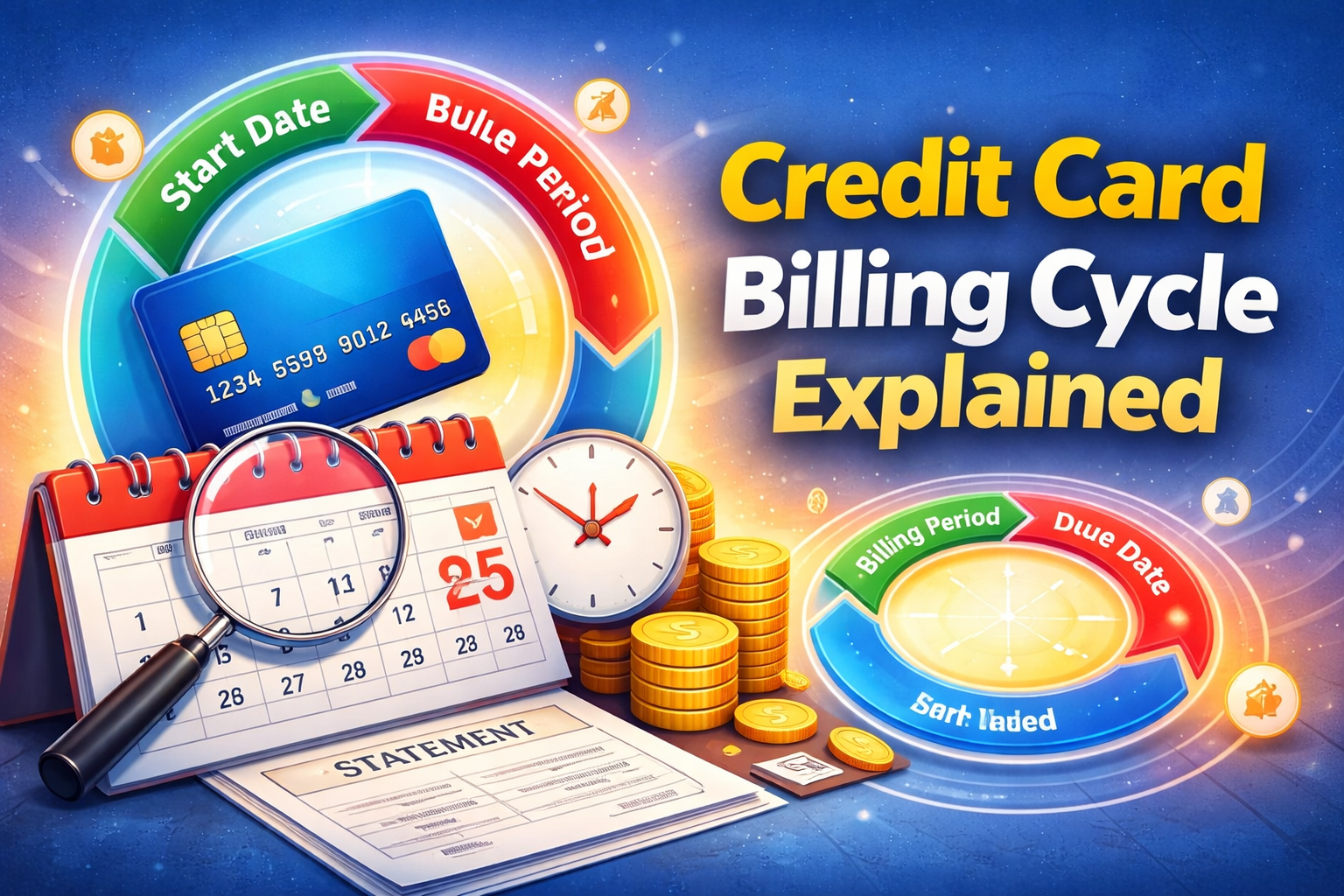
The billing cycle is basically the one-month period during which your bank records all your card transactions. It is like a monthly account book of your spending. Most banks in India follow a 30 or 31-day billing cycle. For example, if your billing cycle starts on the 5th of every month, then from 5th of this month to 4th of next month, whatever you spend using your card will be added in one statement.
This cycle is very important because it decides two major dates:
- Statement Date (also called Billing Date)
- Payment Due Date
Statement Date – When Your Bill is Generated
The statement date is the day your bank closes your monthly account and sends you the credit card statement. On this day, you get the total amount you have spent during that billing cycle.
For example: Your statement date is 10th of every month. You spent ₹15,000 between 10th February and 9th March. On 10th March, your bank will generate a statement showing ₹15,000 as the total due.
You will receive this statement through email, SMS, or in the bank app.
Payment Due Date – Your Last Day to Pay
The due date is the last day by which you must pay your bill. Banks usually give you 15 to 20 days after the statement date to make the payment.
In the above example: Statement Date → 10th March Due Date → Usually 25th or 30th March
If you pay the full amount by the due date, you don’t have to pay even one rupee as interest.
The Golden 50-55 Days Interest-Free Period
This is the biggest advantage of credit cards that most people don’t fully use.
You get an interest-free period of up to 50 to 55 days on your purchases. How?
- Suppose you make a purchase on the first day of your billing cycle.
- Your statement will come after 30 days.
- You still get another 20 days to pay.
Total = Almost 50 days of interest-free credit.
This means you can buy something today and pay after almost 50 days without any interest. This is excellent for managing cash flow, especially for salaried people who get salary at the end of the month.
Minimum Due vs Full Payment – Very Important
Every statement shows two amounts:
- Total Amount Due → Full amount you should pay
- Minimum Amount Due (MAD) → Usually 5% of the total due
Never pay only the minimum due. If you pay only MAD:
- Interest starts immediately on the remaining amount at 3% to 4% per month (36%–48% per year).
- Your CIBIL score gets affected.
- You lose the interest-free period on new purchases.
Always try to pay the full statement amount before the due date.
What Happens If You Miss the Due Date?
- Late payment fee of ₹500 to ₹1,300
- Penal interest on the entire amount
- Negative mark on your CIBIL score
- Future credit limit reduction or card cancellation
Real-Life Example to Understand Better
Let’s say your billing cycle is from 1st to 30th of the month.
- You buy a mobile phone for ₹40,000 on 2nd March.
- Your statement date is 31st March → Bill generated for ₹40,000.
- Due date is 20th April.
You can use this phone for almost 50 days and pay on 19th April without any interest. This is the power of understanding the billing cycle.
Smart Tips to Use Billing Cycle Properly
- Always note down your statement date and due date.
- Set autopay for the full amount in your bank app.
- Try to make big purchases in the beginning of your billing cycle to get maximum interest-free days.
- Track your spends regularly in the app so there are no surprises on statement day.
- If you are unable to pay full, at least pay more than minimum due and clear the rest as soon as possible.
Final Words
Understanding the credit card billing cycle is not difficult, but it is extremely important. Once you know how it works, you can use your credit card like a smart tool instead of a debt trap. A credit card is not extra money — it is borrowed money that you must return on time.
If you still have any doubt about your card’s billing cycle, statement date, or due date, just check your bank app or call customer care. They will tell you exact dates.
Have you ever paid interest because you didn’t understand the billing cycle? Or do you now feel confident after reading this? Share your experience or questions in the comments below. I will try to answer as many as possible.
Stay financially smart, pay your bills on time, and make your credit card work for you — not against you.
Take care friends, and happy responsible spending!
🔥 Related Posts

The Pros and Cons of Secured vs. Unsecured Credit Cards in 2024: A Comprehensive Guide

Buy Now Pay Later vs Credit Cards – Which is Better? (India Guide 2026)
Hidden Charges in Credit Cards You Must Know in 2026: The Fees Banks Don’t Shout About

Comparing Credit Card Interest Rates: Which One is Right for You in 2024?
How Banks Decide Your Credit Card Limit (Internal Algorithms Explained) – India Guide 2026