
Every time you swipe, tap, or enter your card details online, the payment happens in just a few seconds. It feels simple on the surface, but behind that quick transaction is a highly coordinated system involving multiple players. At the centre of this system are payment networks like Visa and Mastercard, which act as the backbone of card-based payments across the world, including India.
To understand how these networks work, it’s important to know that Visa and Mastercard do not issue credit cards themselves. They are not banks, and they don’t lend money to customers. Instead, they provide the infrastructure and technology that allow banks, merchants, and customers to communicate with each other securely and efficiently. In simple terms, they are like the highways on which money travels, while banks are the vehicles that actually carry it.
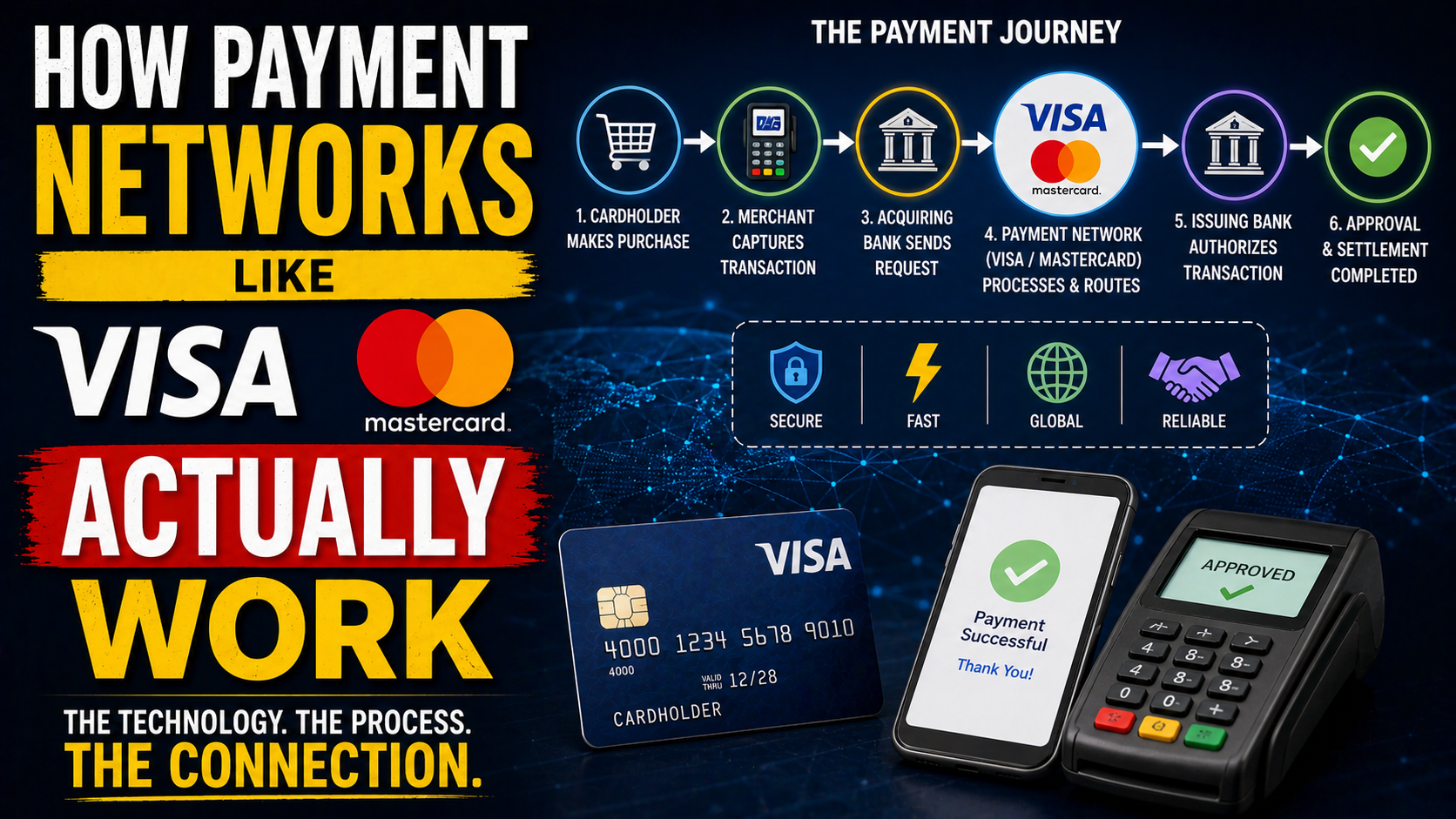
Let’s break down a typical credit card transaction step by step. Imagine you walk into a store and swipe your card to buy something worth ₹2,000. The moment you swipe your card on the POS machine, the merchant’s bank—known as the acquiring bank—sends a request to the payment network. The network then routes this request to the bank that issued your card, called the issuing bank. This entire process happens in a matter of seconds.
Once the issuing bank receives the request, it checks several things. It verifies whether your card is valid, whether you have enough available credit, and whether the transaction appears genuine. If everything looks fine, the bank sends an approval back through the same network. The payment network passes this approval to the merchant’s bank, which then confirms the transaction at the store. From the customer’s point of view, it’s just a quick “approved” message—but behind the scenes, multiple systems have already communicated with each other.
This process is called authorization, but the money doesn’t actually move immediately. The next stage is called clearing and settlement. At the end of the day, all approved transactions are grouped together and processed in batches. The payment network calculates how much money needs to be transferred between different banks. The issuing bank then pays the acquiring bank, which in turn credits the merchant’s account after deducting fees. This entire backend process ensures that funds are transferred accurately and securely.
Security is one of the most critical roles played by payment networks. With millions of transactions happening every day, the risk of fraud is always present. Companies like Visa and Mastercard use advanced technologies such as encryption, tokenization, and real-time fraud detection systems to protect users. For example, when you make an online payment, your actual card details are often replaced with a unique token, reducing the risk of data theft. These networks also monitor transaction patterns and can flag suspicious activity instantly.
Another important function of payment networks is setting the rules and standards for the entire ecosystem. They define how transactions should be processed, how disputes are handled, and how security measures should be implemented. Banks and merchants must follow these rules to participate in the network. This standardization ensures that your card works seamlessly across different countries, platforms, and devices.
Payment networks also play a major role in enabling global acceptance. A card issued in India can be used in another country without any major issues, thanks to the global infrastructure built by Visa and Mastercard. This is especially useful for international travel, online shopping, and cross-border payments. Without these networks, such seamless global transactions would be much more complicated.
From a business perspective, payment networks earn money through transaction fees. Every time you use your card, a small portion of the merchant fee is shared with the network. While this amount may seem tiny per transaction, it adds up significantly given the massive volume of payments processed daily. This is why these companies are among the most profitable in the financial technology space.
It’s also interesting to note how payment networks continue to evolve. In India, with the rise of digital payments, contactless cards, and mobile wallets, networks like Visa and Mastercard are constantly upgrading their systems. They are investing in faster payment technologies, improved security features, and partnerships with fintech companies to stay relevant in a rapidly changing market.
At the same time, India has also developed its own domestic card network through the National Payments Corporation of India, which operates RuPay cards. This has increased competition and provided more options for consumers, while also reducing dependency on global networks for domestic transactions.
In conclusion, payment networks like Visa and Mastercard are the invisible engines that power modern card payments. They don’t issue cards or lend money, but they make it possible for banks, merchants, and customers to interact smoothly and securely. Every swipe, tap, or online payment relies on their infrastructure, rules, and technology. The next time you use your card, it’s worth remembering that behind that simple action is a highly sophisticated system working in real time to make your transaction happen.
🔥 Related Posts

Best Credit Cards Under ₹500 Annual Fee in India 2026

Credit Card Billing Cycle Explained Simply – A Must-Read for Every Indian Card User in 2026

Hidden Charges in Credit Cards You Must Know (India Guide 2026)
Role of the Reserve Bank of India in Regulating Credit Cards in India 2026

Travel More in 2024: Top Credit Cards with Amazing Travel Rewards