Every time you swipe your credit card at a shop, tap it at a POS machine, or pay online, the transaction feels instant and effortless. But behind that smooth experience lies a layered payment system where multiple players are involved—and one of the most important components of this system is the interchange fee. Most consumers in India never notice it directly, yet it plays a huge role in how credit cards work, how banks earn money, and even how rewards are funded.
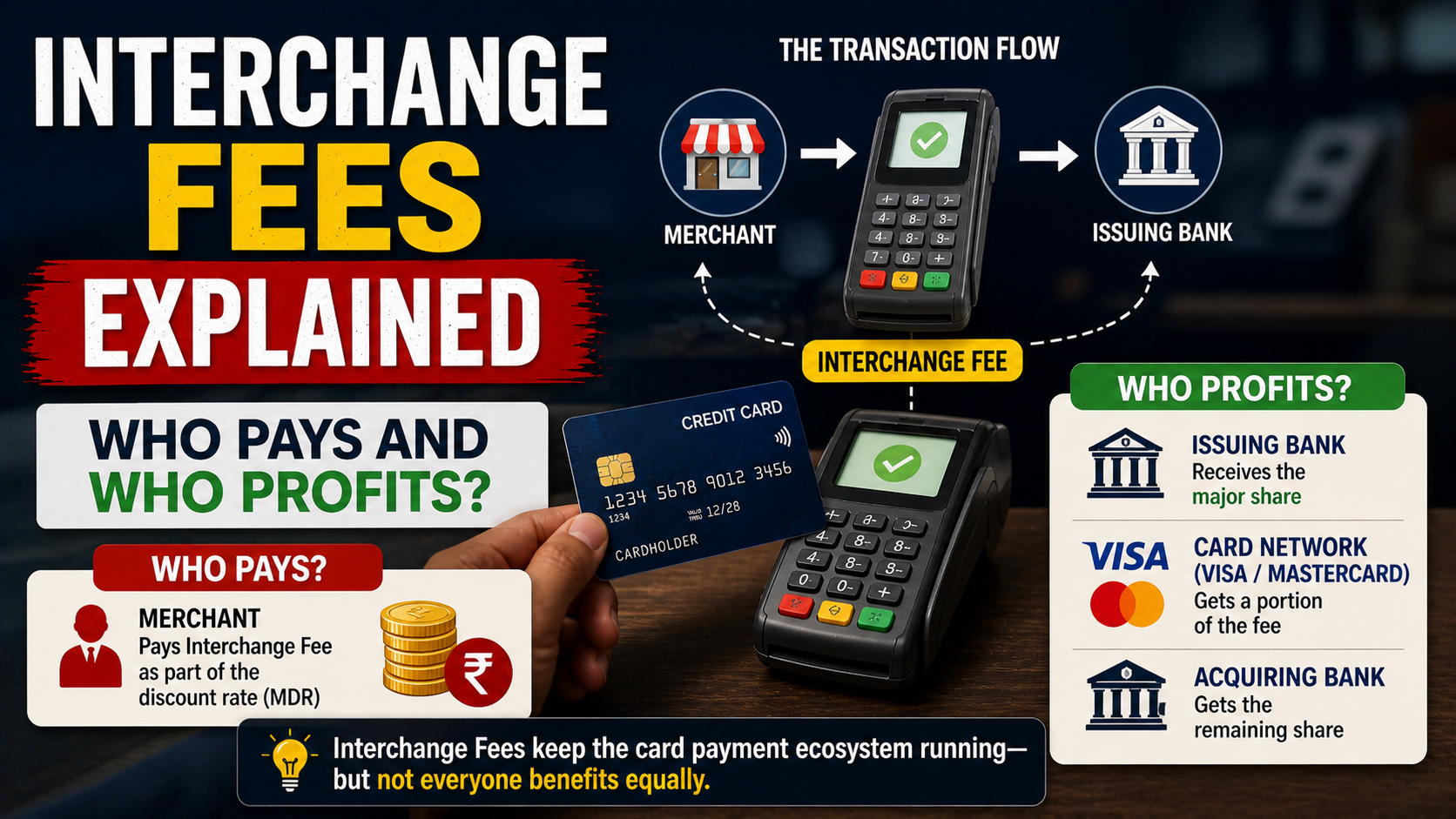
To understand interchange fees in simple terms, think of them as a part of the overall fee charged to merchants when they accept card payments. This broader fee is often referred to as the Merchant Discount Rate (MDR), and the interchange fee is the portion that goes specifically to the bank that issued your credit card. In other words, whenever you make a payment using your card, the merchant pays a small percentage of that transaction, and a part of it flows to your bank as interchange income.
Let’s break this down with a practical example. Suppose you buy something worth ₹1,000 using your credit card. The merchant does not receive the full ₹1,000. Instead, a small fee—say 2%—is deducted as MDR. Out of this ₹20, a portion goes to the issuing bank (as interchange fee), another portion goes to the acquiring bank (the merchant’s bank), and a small share goes to the payment network that processes the transaction. So even if you, as a customer, don’t pay any interest or extra charges, your bank still earns money every time you use your card.
This raises an interesting question: who actually pays the interchange fee? Technically, it is the merchant who pays it directly. However, in reality, the cost is often passed on to customers indirectly. Businesses factor these fees into their pricing, which means the products and services you buy may already include this cost. This is why some small merchants prefer cash payments or offer discounts for non-card transactions—they are trying to avoid paying these fees.
Now let’s look at who profits from interchange fees. The biggest beneficiary is the issuing bank—the bank that gave you the credit card. This fee acts as a reward for taking on the risk of lending money to you and managing your account. The acquiring bank also earns a portion for providing payment infrastructure to the merchant, such as POS machines or payment gateways. Payment networks like Visa and Mastercard take a smaller share for facilitating the transaction and maintaining the network. Together, these entities form a system where every transaction generates income for multiple parties.
Interchange fees are not fixed—they vary depending on several factors. These include the type of card (credit vs debit), the category of the merchant (such as retail, fuel, or travel), the transaction method (online or offline), and even the type of card (premium vs basic). Premium credit cards often have higher interchange fees because they offer more rewards and benefits. This is why banks encourage customers to upgrade to higher-tier cards—they generate more revenue per transaction.
In India, interchange fees and MDR have also been influenced by government policies aimed at promoting digital payments. For example, certain debit card and UPI transactions have zero MDR for merchants, especially for small businesses. However, credit card transactions usually still involve interchange fees, making them a consistent source of income for banks and payment networks. This is one of the reasons why credit cards continue to offer attractive rewards and cashback programs—these benefits are partly funded by interchange revenue.
Speaking of rewards, this is where interchange fees directly impact consumers in a positive way. When you earn cashback, reward points, or discounts on your credit card, a portion of that value is essentially coming from the interchange fee paid by merchants. In simple terms, the more you use your card, the more interchange is generated, and the more room banks have to offer rewards. It creates a cycle where spending drives revenue, and revenue funds incentives.
However, there is also a broader debate around interchange fees. Merchants, especially small businesses, often argue that these fees reduce their profit margins. On the other hand, banks and payment networks justify them as necessary for maintaining infrastructure, security, and innovation in the payment ecosystem. Regulators in different countries, including India, sometimes step in to cap or regulate these fees to ensure a fair balance between all parties.
From a consumer’s perspective, understanding interchange fees helps you see the bigger picture of how credit cards work. Even if you never pay interest or late fees, your card usage still generates income for banks. This explains why banks actively promote credit cards through offers, partnerships, and reward programs—they benefit every time you spend.
In conclusion, interchange fees are a hidden but essential part of the card payment system in India. While merchants pay them directly, the benefits and costs are shared across the entire ecosystem. Banks earn revenue, payment networks sustain operations, merchants gain access to digital payments, and consumers enjoy convenience and rewards. The next time you swipe your card, remember that behind that simple action is a well-structured financial system where interchange fees quietly keep everything running.
🔥 Related Posts

The Pros and Cons of Secured vs. Unsecured Credit Cards in 2024: A Comprehensive Guide

Credit Card Billing Cycle Explained Simply – A Must-Read for Every Indian Card User in 2026

How to Improve Your Credit Score with Credit Card Strategies in 2024

Credit Card Safety Tips for 2024: Protecting Your Digital Wallet

How to Use a Credit Card Without Paying Interest (India Guide 2026)