
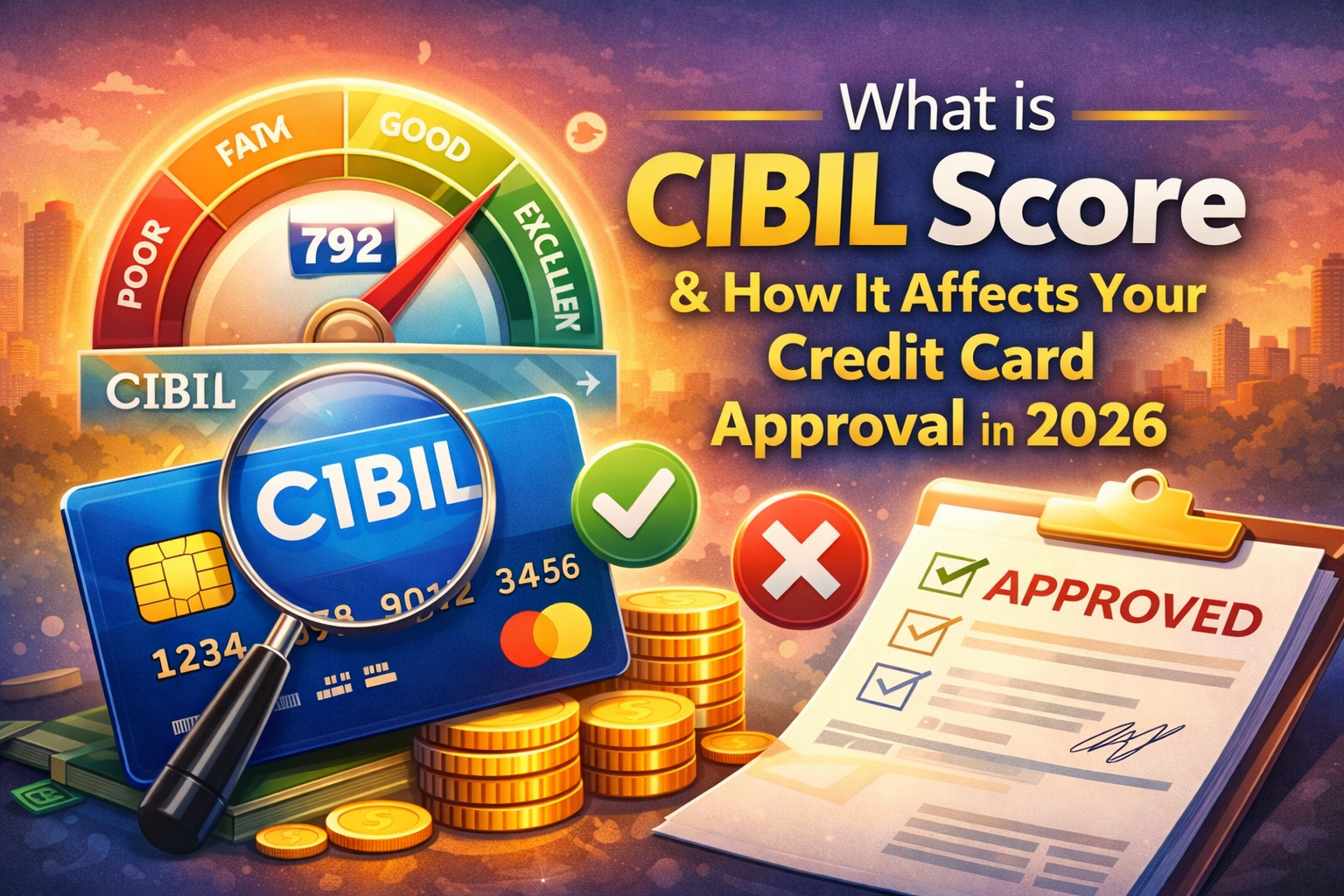
Namaste friends, almost every Indian who has applied for a credit card, personal loan, or home loan has heard the word “CIBIL Score”. But very few people actually understand what it really means and how deeply it affects their financial life. Whether you are a salaried employee in Kolkata, a young professional in Bangalore, or a small business owner in a Tier-2 city, your CIBIL score plays a silent but powerful role when you apply for any credit. In this detailed post, I will explain everything in very simple language — what is CIBIL score, how it is calculated, what is considered good or bad, and most importantly, how it decides whether you will get a credit card approved or rejected.
What is CIBIL Score?
CIBIL (Credit Information Bureau India Limited) is India’s oldest and most popular credit rating agency. Your CIBIL score is a three-digit number between 300 and 900 that shows how responsible you have been with credit in the past. It is like a report card of your borrowing and repayment behaviour.
- 750 – 900 → Excellent Score
- 700 – 749 → Good Score
- 650 – 699 → Fair Score
- 550 – 649 → Poor Score
- 300 – 549 → Very Poor / High Risk
Banks and NBFCs check this score before approving any credit card or loan.
How is CIBIL Score Calculated?
CIBIL score is not decided by one single factor. It is based on several important things:
- Payment History (35%) – This is the most important factor. If you have paid all your EMIs and credit card bills on time for many months, your score becomes strong. Even one or two late payments can drop your score significantly.
- Credit Utilisation (30%) – This shows how much of your available credit limit you are using. Ideally, you should use less than 30% of your total credit limit. For example, if you have a total limit of ₹1 lakh on all cards, try to keep your total outstanding below ₹30,000.
- Length of Credit History (15%) – If you have been using credit cards or loans for many years responsibly, your score improves.
- New Credit Applications (10%) – Applying for too many cards or loans in a short time hurts your score because it looks risky.
- Credit Mix (10%) – Having a healthy mix of credit cards, personal loans, and home loans (if managed well) can help your score.
How Does CIBIL Score Affect Credit Card Approval?
Banks use your CIBIL score as the first filter. Here’s how it works in real life:
- 750 and above: Very high chance of approval. You will get good credit limits and premium cards easily. Banks may even offer you lifetime free cards or high-limit cards without much paperwork.
- 700 – 749: Good chance of approval. You may get normal cards with decent limits. Some banks may ask for income proof.
- 650 – 699: Approval becomes difficult. You may get rejected by private banks. Only some public sector banks or entry-level cards may get approved with low limits.
- Below 650: Almost certain rejection for most good cards. You may only get secured cards (where you give a fixed deposit as security).
In 2026, with increased digital lending, banks have become even stricter. Many fintechs and banks now instantly reject applications if the score is below 700.
Real Life Examples
Rahul from Kolkata has a CIBIL score of 780. He applied for HDFC Regalia and got instant approval with ₹5 lakh limit.
On the other hand, Priya from the same city has a score of 620 because she missed two EMI payments last year. She applied for the same card and got rejected. She had to settle for a basic card with only ₹50,000 limit.
How to Improve Your CIBIL Score in 2026
Good news is — you can improve your score with discipline. Here are practical tips:
- Always pay your credit card bills and EMIs on or before the due date.
- Keep your credit utilisation below 30%.
- Don’t apply for too many cards in a short period (maximum 2–3 applications in 6 months).
- Close old unused credit cards carefully (they can sometimes help your score if managed well).
- Check your CIBIL report once every 3–4 months (you can get one free report every year).
- If you have any old dues or NPA, clear them as soon as possible.
It usually takes 3 to 6 months of good behaviour to see noticeable improvement in your score.
Final Words
Your CIBIL score is not just a number — it is your financial reputation in the eyes of banks. A good score (750+) opens doors to better credit cards, higher limits, lower interest rates, and easy loan approvals. A poor score closes those doors and makes financial life expensive and difficult.
So, start taking your credit behaviour seriously from today. Pay bills on time, control your spending, and check your CIBIL report regularly. In 2026, when almost every bank checks CIBIL instantly, maintaining a strong score has become more important than ever.
Do you know your current CIBIL score? Have you ever faced rejection because of a low score? Share your experience or questions in the comments below. I will try to guide you personally.
Stay financially smart, build a strong credit history, and let your good CIBIL score work for you in 2026 and beyond.
🔥 Related Posts

Hidden Charges in Credit Cards You Must Know in 2026: The Fees Banks Don’t Shout About
EMI on Credit Card: Pros, Cons & Hidden Fees in 2026 – A Straight Talk for Every Indian Wallet

How to Apply for a Credit Card in India in 2026: A Complete Step-by-Step Guide with Eligibility, Documents, and Pro Tips

Cashback vs Reward Points Credit Cards – Which Should You Choose in 2026?

Mastering Credit Card Tricks in 2026: Smart Hacks to Maximize Cashback, Rewards, Lounge Access, and Savings in India