
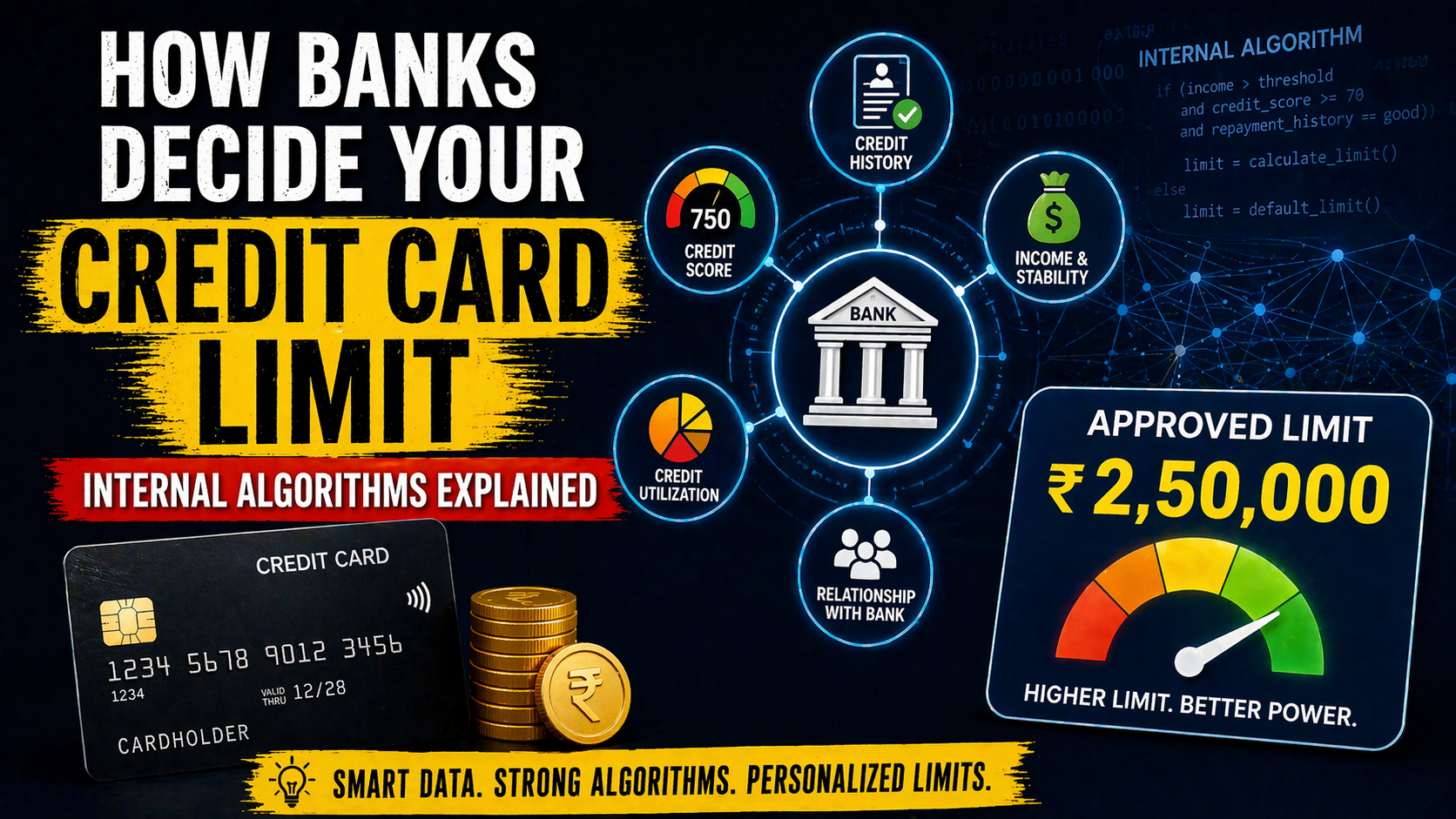
When you receive a credit card in India, one of the first things you notice is your credit limit—the maximum amount you’re allowed to spend. For some people, this limit feels generous, while for others, it may seem surprisingly low. This often leads to a common question: how do banks actually decide your credit card limit? The answer lies in a mix of financial data, risk assessment, and internal algorithms that evaluate your ability to repay borrowed money.
At the most basic level, your income plays a central role in determining your credit limit. Banks use your monthly or annual income as a starting point to estimate how much credit you can comfortably handle. In general, many banks in India offer a credit limit that ranges from 2 to 4 times your monthly salary for entry-level cards. For example, if you earn ₹30,000 per month, your initial limit may fall somewhere between ₹60,000 and ₹1,20,000. However, this is only a rough guideline, not a fixed rule.
Beyond income, your credit score is one of the most important factors. In India, this is commonly known as your CIBIL score. A high score—typically above 750—signals that you have a strong history of repaying loans and managing credit responsibly. This reduces the bank’s risk and can result in a higher credit limit. On the other hand, a lower score indicates potential risk, which may lead to a reduced limit or even rejection of your application.
Banks also carefully evaluate your existing financial obligations. This includes any ongoing loans, EMIs, or other credit card balances you may have. Even if your salary is high, a large portion of your income might already be committed to repayments. Banks calculate something called the debt-to-income ratio, which measures how much of your income is used to pay existing debts. If this ratio is too high, your credit limit may be restricted to ensure you don’t take on more debt than you can handle.
Your employment profile and job stability are also key considerations. Salaried employees working in reputed companies or government jobs are generally seen as lower risk because their income is stable and predictable. Self-employed individuals, freelancers, or those with irregular income may still qualify for credit cards, but banks might assign a lower limit initially. Similarly, if you frequently change jobs or have gaps in employment, it may affect the bank’s confidence in your repayment ability.
Another important but less visible factor is your banking relationship. If you already have a savings account, fixed deposit, or salary account with a bank, they have direct access to your transaction history and spending patterns. This gives them a clearer picture of your financial behaviour, which can lead to better offers and higher credit limits. Customers with long-standing relationships often receive pre-approved credit cards with attractive limits.
Behind the scenes, banks use internal risk models and algorithms to process all this data. These systems analyse multiple variables simultaneously—income, credit score, repayment history, spending patterns, and more—to assign a risk score to each applicant. This risk score helps the bank decide not only whether to approve your application but also how much credit to extend. The goal is simple: offer enough credit to encourage usage while minimizing the risk of default.
Spending behaviour also plays a role over time. When you first receive a credit card, your limit is based on initial data. But as you start using the card, banks monitor how you manage it. If you regularly use your card, pay your bills on time, and keep your balances under control, the bank may increase your limit after a few months. This is often called a credit limit enhancement. On the other hand, if you frequently miss payments or carry high balances, your limit may remain the same or even be reduced.
Credit utilization is another factor that influences limit decisions. Banks prefer customers who use a moderate portion of their available credit rather than maxing out their cards. Consistently using 30% to 40% of your limit and repaying it responsibly signals good financial discipline. This behaviour not only improves your credit score but also increases your chances of getting a higher limit in the future.
There are also cases where banks offer secured credit cards against fixed deposits. In such situations, the credit limit is directly linked to the deposit amount, usually around 75% to 90% of the FD value. Since the bank already holds your money as collateral, the risk is minimal, and the limit is easier to calculate.
It’s important to understand that a higher credit limit is not always a sign of better financial health. While it provides more flexibility and can improve your credit utilization ratio, it also increases the temptation to spend more. Banks design their systems to balance opportunity and risk, but ultimately, the responsibility lies with the user.
If you feel your credit limit is too low, there are ways to improve it. Maintaining a high credit score, increasing your income, reducing existing debts, and building a strong relationship with your bank can all help. You can also request a limit increase manually after demonstrating responsible usage for several months.
In conclusion, your credit card limit is not a random number—it’s the result of a detailed evaluation process powered by data and algorithms. Banks look at your income, credit history, financial obligations, and behaviour to determine how much credit you can handle safely. By understanding how this system works and maintaining good financial habits, you can gradually increase your limit and make the most of your credit card without taking unnecessary risks.
🔥 Related Posts

Credit Card Trends in 2024: What to Expect in Rewards and Benefits

Unlocking Smart Savings in 2026: A Comprehensive Guide to Top SBI Credit Cards, Cashback Rewards, and Premium Facilities

Best Credit Cards for Students in 2024: Building Credit Made Easy

How to Use a Credit Card Without Paying Interest (India Guide 2026)
Credit Card Interest Calculation Formula – Full Breakdown with Examples (India Guide 2026)