
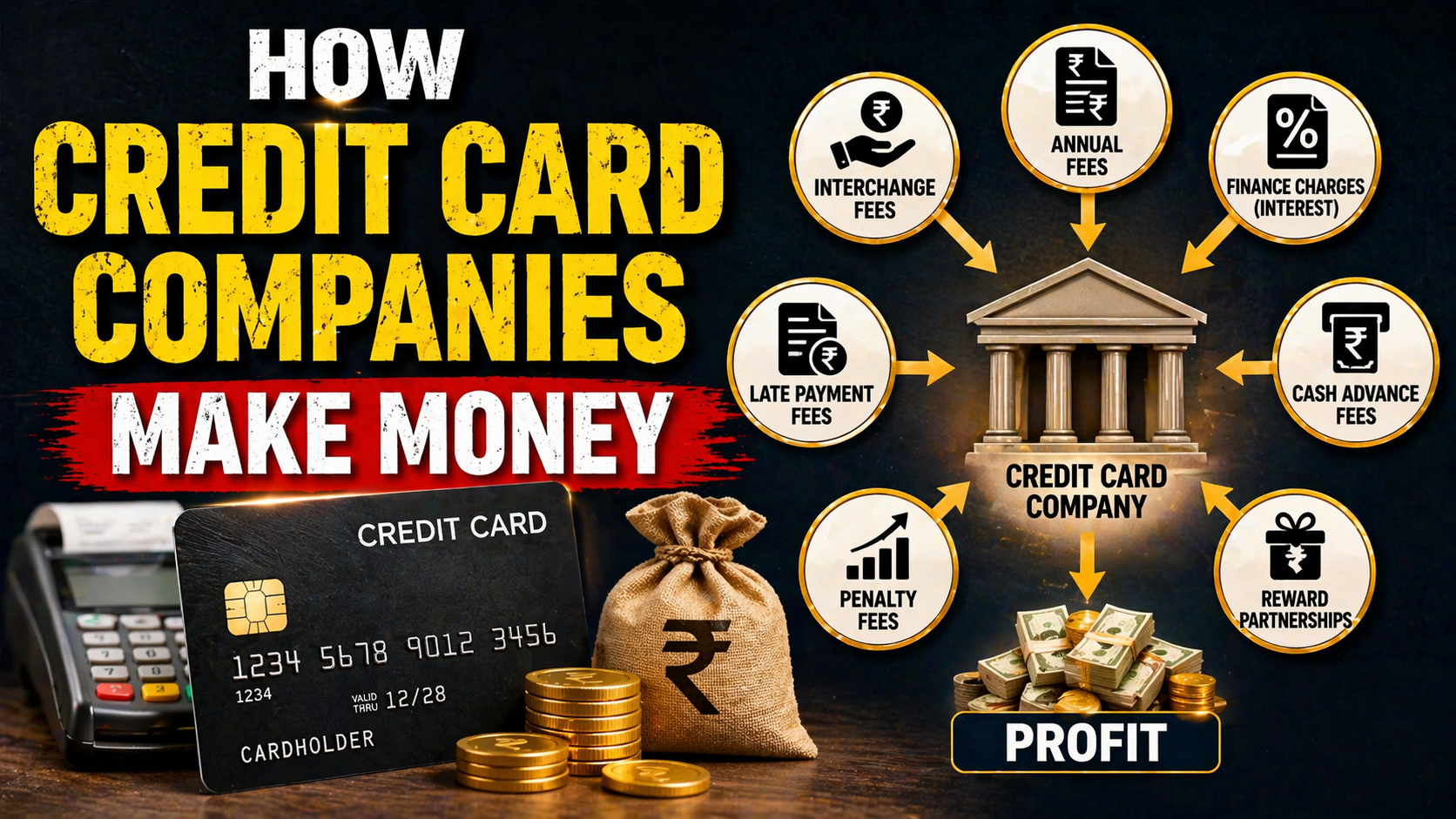
Credit cards may look like a win-win product for customers—cashback, rewards, discounts, and even an interest-free period—but behind all these benefits lies a carefully designed business model. Credit card companies are not offering these perks out of generosity. They are highly profitable financial products, and banks earn money from multiple streams, often in ways that are not immediately visible to the average user. Understanding how credit card companies actually make money can completely change how you use your card and help you avoid unnecessary costs.
At the core of their earnings is interest income, which is the biggest revenue source for most banks. When you use a credit card, you are essentially borrowing money from the bank. If you repay the full amount before the due date, you pay no interest. But the moment you carry forward even a small balance, the bank starts charging interest—often at very high rates, typically between 30% to 45% annually in India. What makes this even more profitable for banks is that interest is calculated daily and compounded, meaning your outstanding amount grows quickly if not cleared. A large portion of credit card users end up paying only the minimum due, and this is exactly where banks make the most money.
Another major source of income is the annual fee. While many cards in India promote themselves as “lifetime free,” others come with yearly charges that can range from a few hundred rupees to several thousand, especially for premium cards. Even when the fee is waived based on spending conditions, banks benefit because it encourages users to spend more than they normally would, indirectly increasing other revenue streams.
One of the most interesting and often overlooked revenue sources is the merchant discount rate, commonly known as MDR. Every time you swipe your credit card at a shop or make an online payment, the merchant pays a small percentage of that transaction to the bank and payment network. This fee typically ranges between 1% to 3% of the transaction amount. While customers don’t see this charge directly, it’s built into the pricing of goods and services. In simple terms, even if you never pay interest, the bank still earns money every time you use your card.
Late payment fees are another significant contributor to bank earnings. If you miss your due date, even by a day, you are charged a penalty. These fees can vary depending on your outstanding amount and can go up to ₹1,000 or more. On top of that, interest continues to accumulate, making it a double source of income for the bank. For customers, it’s a costly mistake; for banks, it’s a steady revenue stream.
Cash withdrawal charges are also highly profitable. When you withdraw cash using your credit card, the bank charges a fee—usually around 2.5% to 3% of the amount withdrawn, along with a minimum charge. Unlike regular purchases, there is no interest-free period here. Interest starts from day one, making it one of the most expensive ways to use a credit card. Banks rely on the fact that many users turn to this option during emergencies, even though it comes at a high cost.
Foreign transaction fees add another layer of earnings. Whenever you use your credit card for international transactions or payments on foreign websites, banks typically charge a markup fee of 2% to 4%. With the rise of global e-commerce, subscriptions, and travel, this has become an increasingly important revenue stream.
EMI conversion charges are another clever way banks make money. Many credit cards offer the option to convert large purchases into easy monthly installments. While some offers are marketed as “No Cost EMI,” there are often hidden processing fees, GST, or reduced discounts that make the transaction slightly more expensive than it appears. Regular EMI options come with interest rates, adding to the bank’s income.
Interchange fees, which are shared between the issuing bank and the card network, also play a role in the overall ecosystem. Whenever a transaction happens, a portion of the merchant fee is distributed among the bank, the payment network, and other intermediaries. This ensures that every swipe contributes to the revenue chain, even if the customer never pays interest.
Additionally, banks earn from value-added services such as insurance, card protection plans, balance transfer fees, and reward redemption charges. For example, transferring your outstanding balance from one card to another may come with a fee, and redeeming reward points might not always be free. These small charges, when multiplied across millions of users, generate substantial income.
It’s also worth noting that credit card companies benefit from customer behavior. Many users tend to overspend because they are not using their own cash immediately. This increased spending leads to higher transaction volumes, which directly boosts the bank’s earnings through merchant fees and other charges. In a way, the entire system is designed to encourage spending while ensuring multiple revenue streams for the issuer.
Despite all these ways of making money, it doesn’t mean credit cards are bad. In fact, if used wisely, you can enjoy all the benefits without paying much to the bank at all. If you always pay your full bill on time, avoid cash withdrawals, and stay within your budget, you can effectively use the bank’s money for free while earning rewards. In this scenario, the bank still earns from merchant fees, but you avoid the costly traps like interest and penalties.
In conclusion, credit card companies in India make money through a combination of interest charges, fees, merchant commissions, and customer behavior. It’s a well-structured system where even small charges add up to massive profits. As a user, the more you understand this system, the better you can navigate it. The goal should not be to avoid credit cards altogether, but to use them smartly—so that instead of becoming a source of expense, they become a tool for financial convenience and rewards.
🔥 Related Posts
What is CIBIL Score & How It Affects Your Credit Card Approval in 2026

Top No Annual Fee Credit Cards in India for 2026: Your Guide to Smart and Cost-Free Spending

How to Apply for a Credit Card in India in 2026: A Complete Step-by-Step Guide with Eligibility, Documents, and Pro Tips

The Pros and Cons of Secured vs. Unsecured Credit Cards in 2024: A Comprehensive Guide

Credit Card Safety Tips for 2024: Protecting Your Digital Wallet